How to Build a Modern Data Pipeline in 2026
The global data pipeline market is projected to reach $43.61 billion by 2032. This architect's guide covers the production-grade ELT patterns, tooling decisions, and governance frameworks that separate high-performing pipelines from expensive failures.


- The data pipeline market is growing from $12.26 billion (2025) to $43.61 billion by 2032, driven by AI, real-time processing, and cloud-native adoption.
- Modern pipelines follow the ELT pattern — Extract, Load, Transform — leveraging cloud warehouse compute for transformations.
- dbt is used by 8,200+ companies globally and has become the industry standard for SQL-based data transformation.
- 85% of enterprises plan to modernize their data platforms by 2026, making pipeline architecture a strategic priority.
Why Data Pipelines Are a Strategic Priority
Data pipelines have evolved from back-office infrastructure into a strategic asset. In 2026, 85% of enterprise technology leaders are prioritizing data platform modernization, driven by the rise of Generative AI and the need for analytics-ready data at scale (DBTA, 2025).
The organizations that treat their data pipeline as a product — with clear SLAs, documented ownership, and automated quality controls — are the ones extracting measurable value from AI, advanced analytics, and real-time decision-making.
At Alfa Analytics, we've architected 400+ production data pipelines across 18 industries. This guide distills the architecture patterns, tooling decisions, and governance practices that consistently deliver results.
The Modern ELT Architecture
The most significant shift in data engineering over the past three years has been the move from ETL (Extract, Transform, Load) to ELT (Extract, Load, Transform). In the ELT paradigm, raw data is loaded into a cloud data warehouse first, then transformed using SQL-based tools. This approach offers three critical advantages:
- Scalability: Cloud warehouses like Snowflake and BigQuery provide elastic compute, allowing transformations to run on massive datasets without infrastructure bottlenecks.
- Flexibility: Raw data is preserved, enabling analysts to create new transformations without re-ingesting from source systems.
- Auditability: Every transformation is version-controlled SQL, creating a complete lineage from source to dashboard.
Layer 1: Extraction & Ingestion
The ingestion layer connects to source systems and lands raw data in your warehouse. Two primary approaches dominate enterprise deployments:
Managed connectors (Fivetran, Airbyte, Stitch) handle the majority of SaaS and database sources — Salesforce, HubSpot, PostgreSQL, Stripe, Google Analytics. These tools handle schema changes, rate limits, and incremental syncing automatically, reducing engineering overhead by 60–70%.
Custom ingestion is required for proprietary APIs, legacy systems, and real-time streaming sources. In these cases, we build Python-based extractors deployed as containerized services, with Apache Kafka or AWS Kinesis for event streaming.
Layer 2: Cloud Data Warehouse
The warehouse is the central hub of the modern data stack. Platform selection depends on existing cloud investments, workload requirements, and team capabilities:
- Snowflake: Best for multi-cloud deployments, data sharing, and organizations requiring strict separation of storage and compute. Snowflake's credit-based pricing model requires active governance to prevent cost overruns.
- Google BigQuery: Best for GCP-native organizations. Its serverless, pay-per-query model eliminates infrastructure management, though costs can spike unpredictably with complex queries.
- Databricks: Best when analytics and machine learning coexist in a single platform. The lakehouse architecture supports both structured SQL workloads and unstructured ML training data.
For regulated industries (healthcare, financial services), Snowflake and Azure Synapse offer the most comprehensive compliance certifications — SOC 2 Type II, HIPAA BAA, FedRAMP, and GDPR controls out of the box.
Layer 3: Transformation with dbt
dbt (Data Build Tool) has become the industry standard for data transformation, used by over 8,200 companies globally, including Spotify, GitLab, and JetBlue. The October 2025 merger between Fivetran and dbt Labs signals the market's consolidation around this approach — unified ingestion and transformation in a single governed pipeline.
dbt brings software engineering practices to analytics: version control, modular code, automated testing, and generated documentation. A well-structured dbt project follows a three-layer architecture:
- Staging layer (stg_): One-to-one mirrors of source tables with basic cleaning — type casting, renaming, and deduplication.
- Intermediate layer (int_): Business logic joins, aggregations, and calculations that combine multiple staging models.
- Marts layer (marts_): Analytics-ready tables optimized for BI tools and downstream consumers — one table per business entity or KPI domain.
-- Example: Staging model for customer data (stg_customers.sql)
WITH source AS (
    SELECT * FROM {{ source('ecommerce', 'raw_customers') }}
),
cleaned AS (
    SELECT
        id AS customer_id,
        LOWER(TRIM(email)) AS email,
        COALESCE(first_name || ' ' || last_name, 'Unknown') AS full_name,
        created_at::DATE AS signup_date,
        updated_at::TIMESTAMP AS last_modified,
        ROW_NUMBER() OVER (PARTITION BY id ORDER BY updated_at DESC) AS row_num
    FROM source
    WHERE email IS NOT NULL
)
SELECT * FROM cleaned WHERE row_num = 1
Layer 4: Orchestration & Observability
Orchestration ensures pipelines execute in the correct order, with proper error handling and alerting. The three leading options serve different organizational profiles:
- Apache Airflow (via Astronomer or MWAA): The enterprise default for complex DAGs with cross-system dependencies. Best for organizations with dedicated platform engineering teams.
- Dagster: A modern alternative emphasizing software-defined assets and built-in data lineage. Increasingly popular with teams adopting Data Mesh principles.
- Prefect: Ideal for Python-centric teams who need lightweight orchestration without Airflow's operational complexity.
Data observability — monitoring data quality, freshness, and volume in production — has emerged as a critical discipline in 2026. Tools like Monte Carlo, Elementary, and Soda provide automated anomaly detection, alerting teams to pipeline failures before they impact business decisions.
Layer 5: Serving & Visualization
The serving layer connects transformed data to business consumers via dashboards (Power BI, Tableau, Looker), embedded analytics, or reverse ETL tools (Census, Hightouch) that push insights back into operational systems like Salesforce, HubSpot, and Intercom.
Governance: The Differentiator
The technical architecture is only half the equation. Enterprise-grade pipelines require governance frameworks that address:
- Data contracts: Formal agreements between data producers and consumers on schema, freshness, and quality expectations.
- Access controls: Role-based permissions following least-privilege principles, with environment-specific access (dev, staging, production).
- Cost governance: Automated alerts for warehouse spend thresholds, query optimization reviews, and reserved compute policies.
- Documentation: dbt's auto-generated docs, data dictionaries, and lineage graphs maintained as living artifacts, not afterthoughts.
Common Anti-Patterns
- Over-engineering on day one: Start with a proven stack (Fivetran → Snowflake → dbt → Power BI), validate with one data domain, then expand. Kubernetes-based orchestration is rarely necessary for initial deployments.
- Skipping data quality testing: Every dbt model should include schema tests (not_null, unique, accepted_values) and custom data tests. The cost of a data quality issue reaching a boardroom dashboard far exceeds the cost of prevention.
- Ignoring cost governance: Without monitoring, Snowflake and BigQuery costs can scale 5–10x within a quarter. Implement usage dashboards and automated cost alerts from day one.
- Treating documentation as optional: Undocumented pipelines become technical debt that compounds monthly. dbt's built-in documentation generation reduces this burden significantly.
Real-World Implementation: E-Commerce Analytics Platform
For a DTC e-commerce brand processing 50,000+ daily orders, we architected a pipeline consolidating data from Shopify, Google Ads, Meta Ads, Klaviyo, and Stripe into Snowflake. Using dbt, we built a unified customer model with RFM segmentation and CLV predictions. Results within 90 days:
- 35% reduction in wasted ad spend through data-driven audience suppression
- 4-hour data freshness (down from 24 hours with the legacy batch process)
- Self-service analytics for the marketing team via Power BI dashboards with natural language query support
Implementation Timeline
A production-grade data pipeline can be operational in 4–6 weeks with the right planning and tooling:
- Week 1: Requirements gathering, source system audit, warehouse provisioning
- Weeks 2–3: Ingestion pipeline setup, staging models, initial dbt project structure
- Week 4: Business logic transformations, data quality tests, dashboard development
- Weeks 5–6: Orchestration, monitoring, documentation, team training, and production launch
Ready to modernize your data infrastructure? Book a free 30-minute consultation with our data engineering team to assess your current architecture and identify optimization opportunities.
Written by Ali Raza
Founder & CEO at Alfa Analytics
Helping enterprises turn data into revenue. Expert in data engineering, BI dashboards, and analytics strategy across 18+ industries.
Ready to transform your data into results?
Our team has delivered 400+ analytics projects across 18 industries. Book a free 30-minute consultation to discuss how we can help.
More from Alfa Analytics
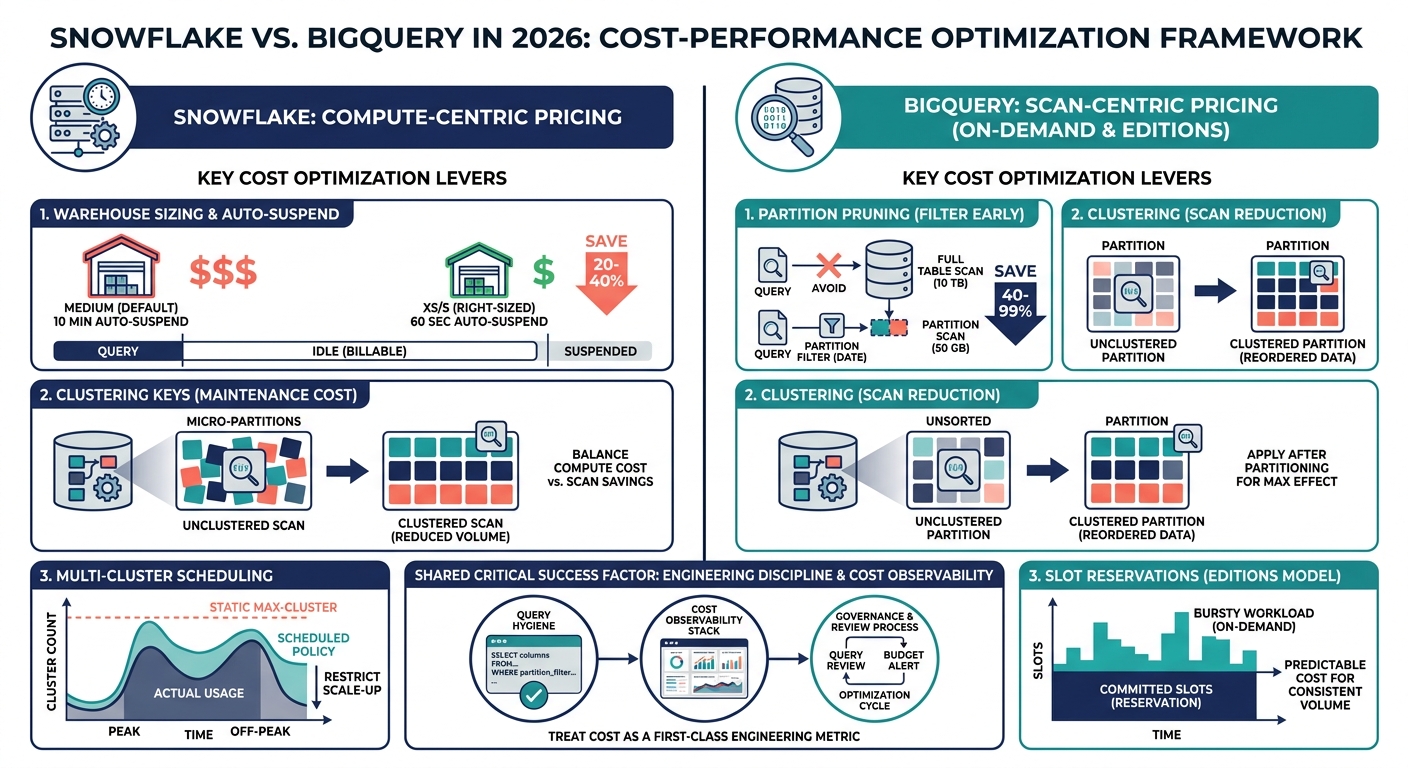
Snowflake vs. BigQuery in 2026: A CTO's Guide to Cost-Performance Optimization
Snowflake and BigQuery are both capable at scale, but capability is not the differentiator in 2026. Cost governance is. This post breaks down the compute and storage economics of both platforms and gives CTOs the specific clustering, partitioning, and SQL optimization techniques that actually move the needle on warehouse spend.
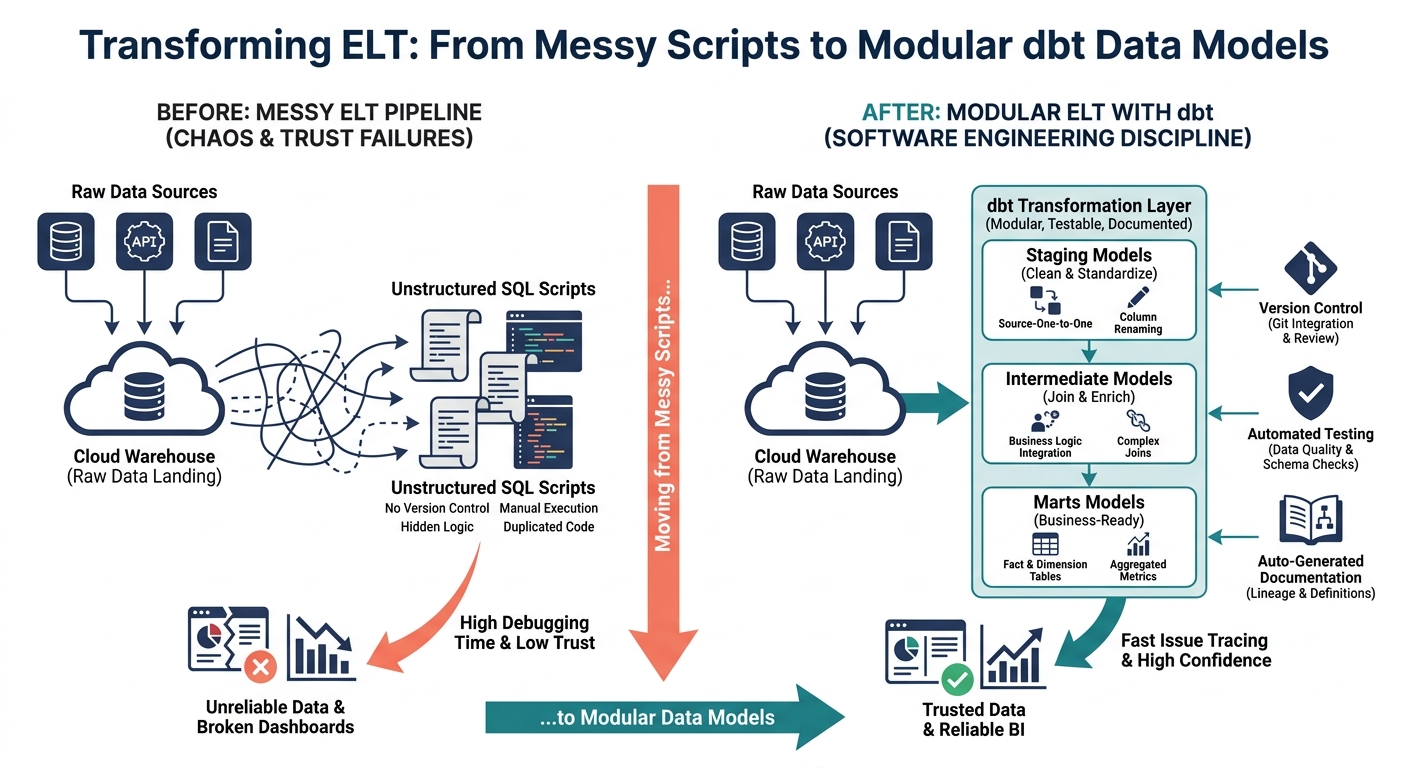
Why Your ELT Pipeline Needs dbt: Moving from Messy Scripts to Modular Data Models
Messy SQL scripts and undocumented transformation logic are among the leading causes of data trust failures in modern analytics teams. This post explains how dbt brings software engineering discipline to your ELT pipeline and what it actually takes to build a modular, testable, and documented transformation layer that your BI tools can rely on.