Tableau Server Performance Optimization
Key Results
Reduction in extract refresh time (1hr → 15min)
Server crashes during peak usage (from 3/month)
Improvement in dashboard load times
1The Challenge
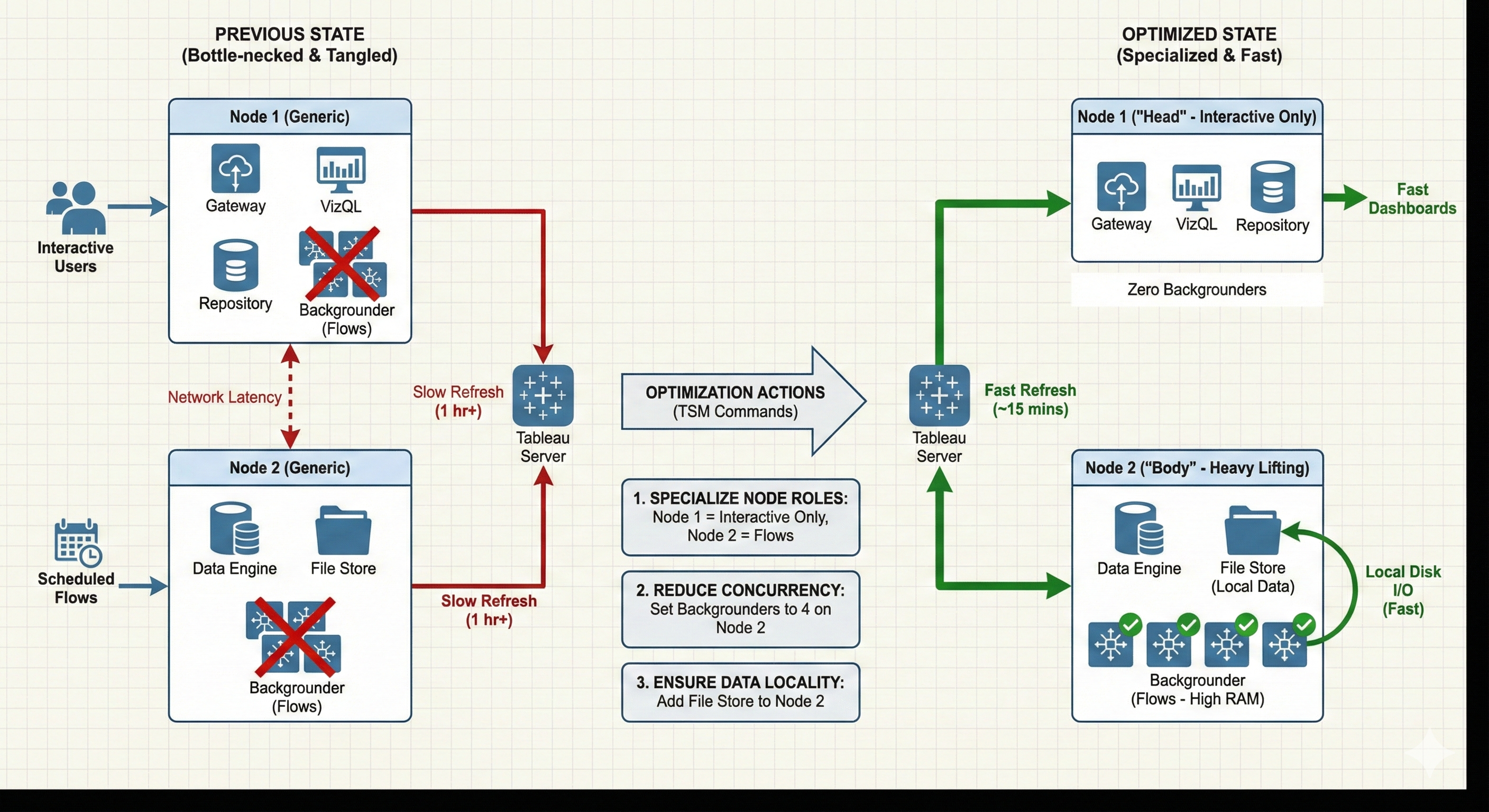
Tableau Server was experiencing severe performance issues with 1-hour+ refresh times, bottlenecked backgrounders, and frustrated business users unable to access timely reports. The two-node cluster was under-optimized and misconfigured.
2Our Solution
Conducted a comprehensive performance audit and redesigned the server architecture. Specialized nodes for different workloads, optimized backgrounder concurrency, and implemented data locality best practices to achieve 15-minute refresh times.
Our Approach
Analyzed existing two-node architecture and identified bottlenecks in backgrounder processes
Redesigned Node 1 as "Head" node for interactive workloads only (Gateway, VizQL, Repository)
Configured Node 2 as "Body" node for heavy lifting (Data Engine, File Store, Backgrounders)
Reduced backgrounder concurrency from 8 to 4 on Node 2 to prevent resource contention
Moved File Store to Node 2 with local SSD storage for faster data access
✓The Impact
Reduction in extract refresh time (1hr → 15min)
Server crashes during peak usage (from 3/month)
Improvement in dashboard load times
Technology Stack
Project Details
Client
Enterprise Analytics Team
Industry
Data Engineering
Duration
2 weeks
Want to achieve similar results for your data engineering organization?
More Data Engineering Projects
Social Media ETL Pipeline
The client was manually exporting data from 5+ social media platforms (YouTube, Facebook, Instagram, TikTok) weekly, leading to inconsistent reporting and 8+ hours of analyst time wasted on data collection instead of insights.
View Case StudyGifting Platform Data Warehouse
A fast-growing corporate gifting platform had data scattered across their operational database, Snowflake historical data, and third-party APIs. Executive team lacked visibility into key business metrics and couldn't access insights without engineering support.
View Case Study