Why Your ELT Pipeline Needs dbt: Moving from Messy Scripts to Modular Data Models
Messy SQL scripts and undocumented transformation logic are among the leading causes of data trust failures in modern analytics teams. This post explains how dbt brings software engineering discipline to your ELT pipeline and what it actually takes to build a modular, testable, and documented transformation layer that your BI tools can rely on.

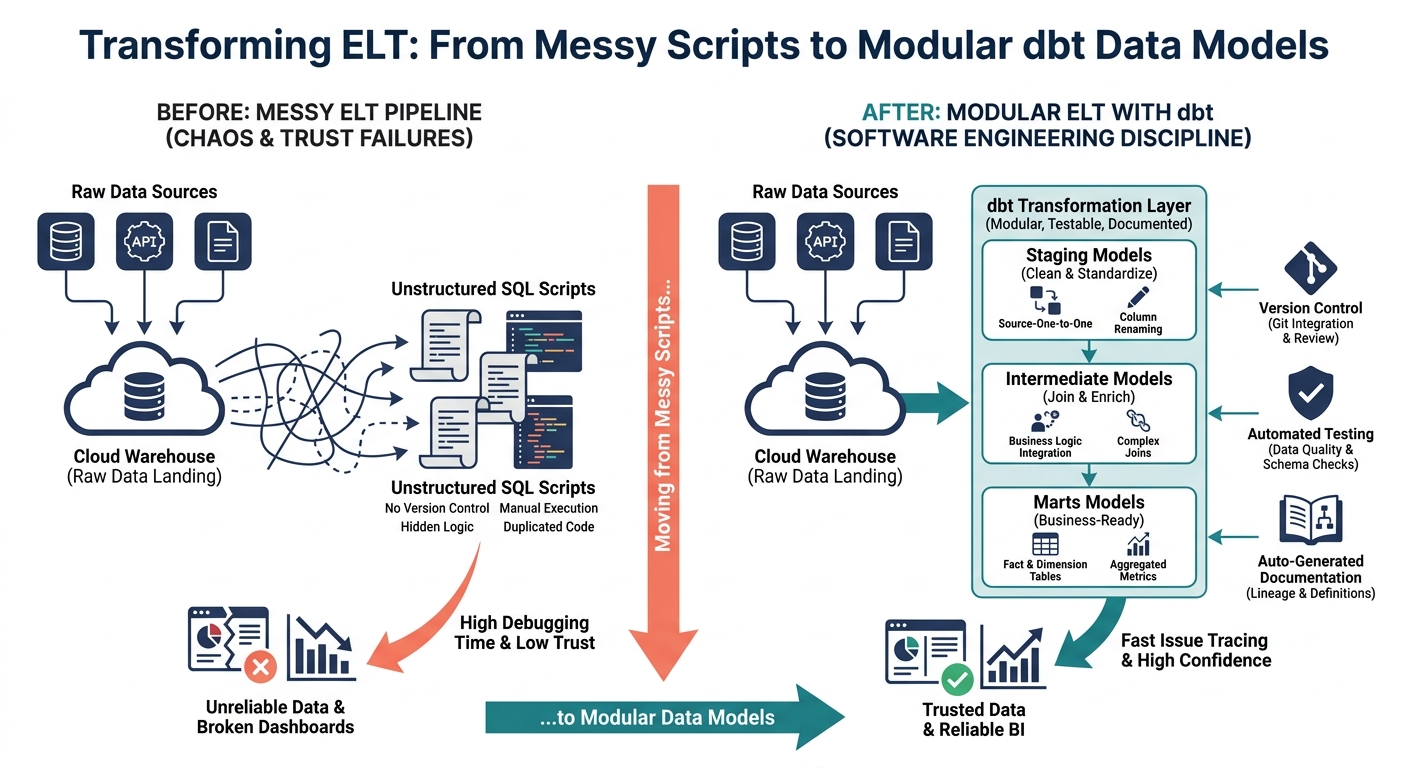
Most data teams reach a breaking point somewhere around the 40th SQL file in a shared folder. According to a 2024 survey by dbt Labs, 73% of data practitioners reported that undocumented or poorly organized transformation logic was a leading cause of trust issues with their data warehouse. That number should alarm anyone running a modern analytics operation.
1. The problem is transformation chaos, not source data quality 73% of data practitioners cite disorganized transformation logic as the root cause of data trust failures, not what comes in, but what happens after.
2. dbt enforces modular, layered modeling that scales Staging, intermediate, and mart layers make transformation logic readable, testable, and auditable without rebuilding your entire pipeline.
3. Built-in testing catches issues before they reach your dashboards Not-null, uniqueness, and referential integrity checks surface data quality problems at the model level, not in the executive report.
4. Git integration brings software engineering standards to data teams Every transformation change is tracked, reviewable, and reversible — a practice most data teams have historically skipped entirely.
5. dbt closes the gap between what analysts assume and what engineers built Auto-generated documentation from model definitions and YAML files gives every team member a shared, always-current source of truth.
The Big Picture
Data engineering borrowed the warehouse idea from software but left the engineering discipline behind. For years, the dominant pattern was a folder of SQL scripts, sometimes numbered, sometimes not, executed in a sequence that only one person truly understood. That one person became the single point of failure. When they left or got pulled into something else, the pipeline became archaeology. The shift to ELT, where raw data lands in a cloud warehouse first and transformation happens inside the warehouse, should have improved things. It gave teams more flexibility and access to scalable compute. But it did not fix the organizational problem. Teams simply moved their spaghetti scripts into Snowflake, BigQuery, or Redshift and kept running them in the same unstructured way. The warehouse got faster. The code got no better. dbt (data build tool) exists specifically to address this gap. It applies the core principles of software engineering, modularity, version control, testing, and documentation, to SQL-based transformations. It does not replace your warehouse or your orchestration layer. It gives your transformation logic the structure and discipline that a production-grade engineering system demands.
What's Delivering Measurable Impact
Layered Modeling That Replaces Spaghetti Logic
dbt's convention of staging, intermediate, and mart layers forces teams to separate raw data ingestion from business logic and from final reporting outputs. Each layer has a clear responsibility. Staging models clean and standardize source data. Intermediate models join and enrich. Mart models expose polished, business-ready tables. This structure alone eliminates the most common failure mode in messy pipelines, where transformation logic, business rules, and raw field references are all tangled in one 800-line query.
Testing That Runs Automatically on Every Build
dbt ships with a built-in test framework that lets you define expectations directly in YAML files sitting alongside your models. You can assert that a primary key column is unique and not null, that a foreign key references a valid record in another table, or that a status field only takes accepted values. These tests run on every dbt build, meaning a bad transformation does not silently corrupt a downstream dashboard. It fails loudly, where the problem actually is.
Git-Based Version Control for Every Transformation
When every dbt model is a file in a Git repository, every change is a commit. Pull requests, code reviews, branch-based development, and rollbacks become standard practice for data transformations, exactly as they are for application code. This is not theoretical. It means that when a model breaks in production, you know exactly what changed, who changed it, and when. That level of accountability is impossible to achieve with a folder of SQL files updated directly on a shared drive.
Auto-Generated Lineage and Documentation
dbt builds a DAG (directed acyclic graph) of your entire transformation pipeline based on the ref() functions you use to connect models. This lineage is visible in dbt's documentation site, which it generates automatically from your model definitions and YAML descriptions. Every model shows its upstream sources and downstream dependents. Analysts can see exactly where a metric comes from. Engineers can understand the blast radius of changing a staging model before they touch it.
Modular Reusability with Macros and Packages
dbt supports Jinja templating and a macro system that lets you write reusable SQL logic once and call it across many models. Common patterns like date spine generation, session attribution, or fiscal calendar logic can be packaged and shared. The dbt Hub ecosystem also provides pre-built packages for sources like Stripe, Salesforce, and GitHub, so teams are not rebuilding standard transformations from scratch.
What's Still Overpromised
dbt Solves Your Data Governance Problem
dbt is a transformation framework, not a governance platform. It helps document and test your models, but it does not manage access controls, enforce data contracts across organizational boundaries, or replace a proper data catalog. Teams that adopt dbt expecting it to single-handedly deliver governance are usually disappointed when they realize they still need complementary tooling for cataloging, lineage at the organizational level, and policy enforcement.
dbt Eliminates the Need for Orchestration
dbt runs transformations but does not schedule or orchestrate them. You still need a tool like Airflow, Prefect, or Dagster to trigger dbt runs, handle dependencies with upstream ingestion jobs, and manage retries and alerting. The confusion is understandable since dbt has its own DAG, but that DAG only covers model execution order within a single run. The broader orchestration question is entirely outside dbt's scope.
dbt Core Is Low-Effort to Adopt
dbt Core, the open-source version, requires meaningful setup effort. You need to configure your profiles, manage your Git workflow, decide on your project structure, write your YAML files, and integrate with your CI/CD tooling. For teams without a dedicated data engineer, that ramp is non-trivial. dbt Cloud reduces friction with a managed IDE and job scheduler, but it introduces a cost that some organizations underestimate when budgeting for the transition.
Implementation Framework
Where to Start
Before writing a single dbt model, audit your existing transformation layer. Map out every SQL script or stored procedure currently powering your BI tools, identify which ones encode business logic versus which are purely structural transforms, and document where the same calculation appears in more than one place. That audit tells you which models to build first and which duplication problems dbt will immediately solve. Your first dbt project should target one critical reporting area, a revenue model or a customer activity mart, not the entire warehouse at once.
Where Most Teams Go Wrong
The most common mistake is converting existing scripts into dbt models one-for-one without rethinking the structure. Teams take a 600-line query and drop it into a single dbt model, get the tests running, and call it done. This misses the entire point. The value comes from decomposing that query into properly layered models with clear responsibilities at each stage. Skipping the restructuring step means you have the same spaghetti logic, just with version control on top, and you have not gained the modularity or testability that make dbt worth adopting.
Critical Success Factor
The Road Ahead
The direction of the data engineering field is unmistakably toward treating data assets with the same engineering rigor applied to software. The emergence of the analytics engineering role, practitioners who sit at the intersection of data engineering and business intelligence, reflects that shift. Tools like dbt are central to that role. As organizations push further into self-serve analytics and federated data ownership models, the teams that have invested in clean, tested, documented transformation layers will be the ones who can actually deliver on those promises without creating new versions of the same governance chaos. The organizations still running transformation logic in ad hoc scripts will find themselves increasingly unable to scale, unable to audit, and unable to build trust with the business stakeholders who depend on their numbers. If your team is at that inflection point, we can help you build a dbt project structure that reflects your actual business domains, sets your BI tools up for reliable, single-source-of-truth reporting, and gives your engineers a codebase they are not afraid to touch. Book a consultation with Alfa Analytics and let us show you what a production-grade transformation layer actually looks like.
Written by Mohsin Tanveer
Co-Founder & CTO at Alfa Analytics
Full-stack architect and AI solutions engineer who designs the scalable infrastructure behind every analytics product. Expert in cloud-native data platforms, real-time processing pipelines, and deploying machine learning models at production scale — ensuring every solution is fast, reliable, and built to grow.
Ready to transform your data into results?
Our team has delivered 400+ analytics projects across 18 industries. Book a free 30-minute consultation to discuss how we can help.
More from Alfa Analytics
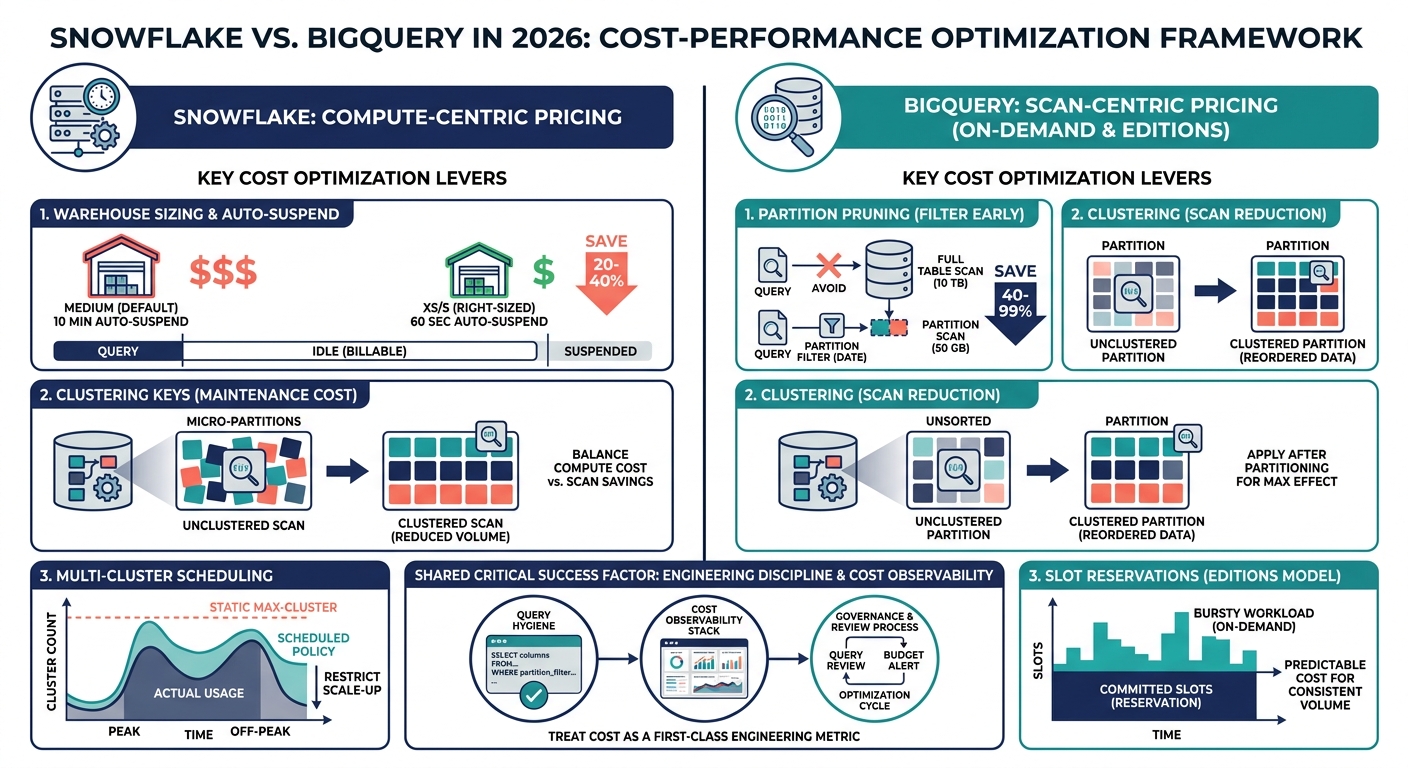
Snowflake vs. BigQuery in 2026: A CTO's Guide to Cost-Performance Optimization
Snowflake and BigQuery are both capable at scale, but capability is not the differentiator in 2026. Cost governance is. This post breaks down the compute and storage economics of both platforms and gives CTOs the specific clustering, partitioning, and SQL optimization techniques that actually move the needle on warehouse spend.

How to Build a Modern Data Pipeline in 2026
The global data pipeline market is projected to reach $43.61 billion by 2032. This architect's guide covers the production-grade ELT patterns, tooling decisions, and governance frameworks that separate high-performing pipelines from expensive failures.