Compute Is the New Oil: Here Is the Proof
The four largest hyperscalers are projected to spend $765 billion on AI infrastructure in 2026, and BlackRock is already calling compute the next crude oil futures market. This post breaks down the economic, geopolitical, and strategic proof that compute has crossed from utility to critical resource, and what that means for how you plan your technology investments.

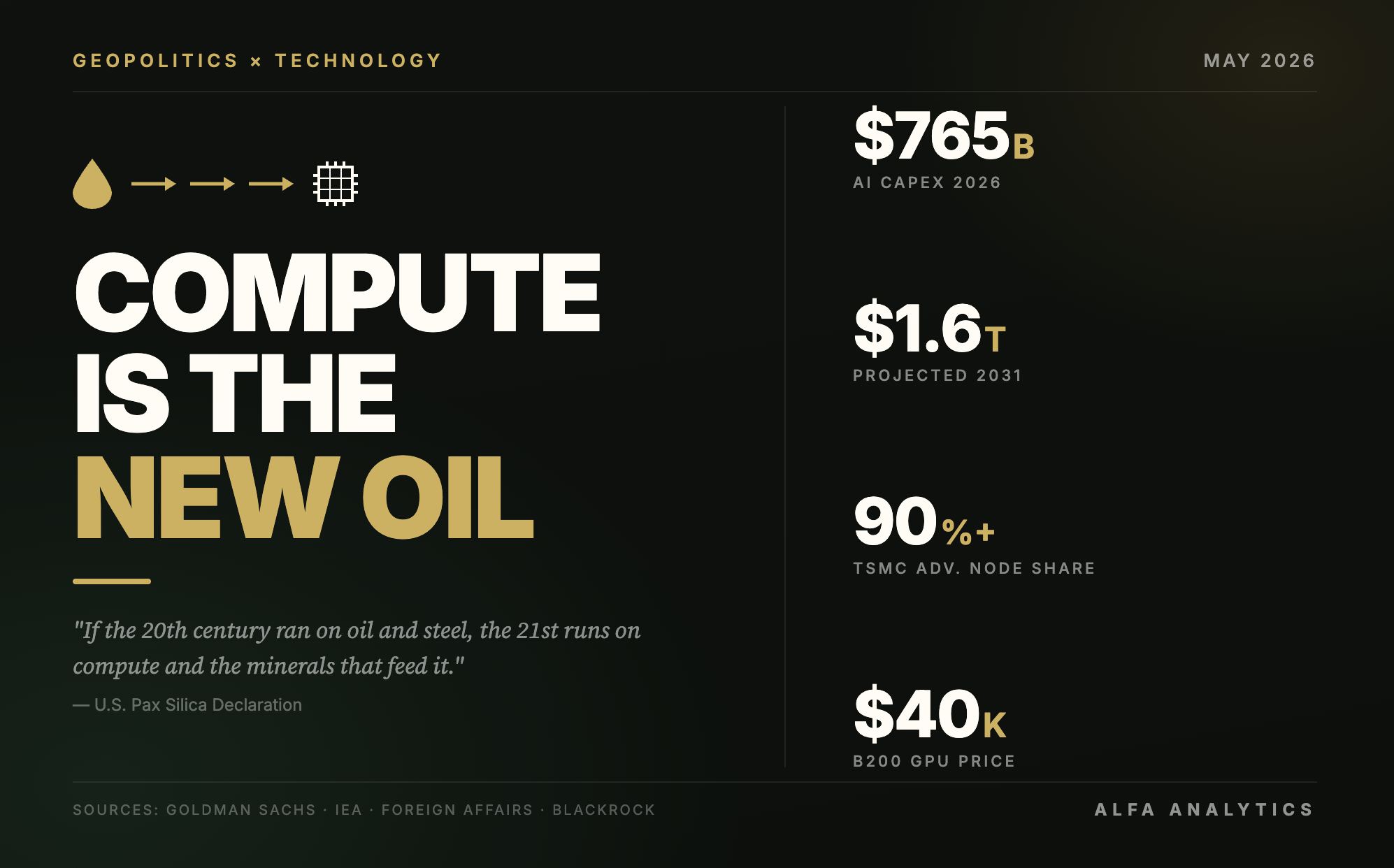
The U.S. State Department's Pax Silica Declaration puts it without ceremony: "If the 20th century ran on oil and steel, the 21st century runs on compute and the minerals that feed it." According to Goldman Sachs research published in 2025, the four largest hyperscalers were projected to spend $765 billion in AI capital expenditure in 2026 alone, scaling to $1.6 trillion annually by 2031. This is not a metaphor or a conference keynote talking point. It is an investment thesis backed by sovereign capital, reshaping geopolitics, and rewriting the rules of competitive advantage for every company that touches data.
1. Hyperscaler CapEx confirms compute has become a strategic commodity Goldman Sachs 2025 projections put combined hyperscaler AI infrastructure spend at $765 billion in 2026, a number that dwarfs most national GDP figures.
2. Geographic concentration in chip manufacturing creates systemic risk TSMC commands over 90 percent of the world's most advanced chip production at the 5nm node and below, manufacturing from a single geographic location — making semiconductor supply more fragile than any oil chokepoint in history.
3. Compute scarcity already behaves like commodity scarcity, complete with price spikes NVIDIA's Blackwell B200 GPUs are sold out through mid-2026 with a backlog of 3.6 million units, sale prices around $40,000 per chip, and cloud rental rates surging 24% in a single month. Blackwell PRO GPUs now carry lead times of three to seven months, while a global memory shortage in HBM, GDDR7, and DRAM is pushing consumer GPU prices up 15–30%.
4. Nations have replaced oil pipelines with GPU pipelines as strategic assets Gulf states once relevant only for crude are now positioning as the world's third-largest AI compute hub, shifting the entire geopolitical calculus of the US–Gulf relationship.
5. Most companies still treat compute as a cost line, not a strategic resource Organizations that fail to treat compute allocation as a capital planning decision are making the same mistake manufacturers made before they realized energy was a competitive variable.
The Big Picture
For most of the last decade, compute was a utility. You consumed it the way you consumed electricity: pay the invoice, scale up when needed, optimize when the CFO complained. That mental model is now dangerously outdated.
When BlackRock's Larry Fink stated publicly in May 2025 that compute demand could birth an entirely new asset class called "compute futures" — modeled on how crude oil futures emerged after the 1973 OPEC shock — that was not speculation from a technologist. That was a signal from the world's largest asset manager that the financial architecture around compute is about to become as sophisticated as the one around energy.
The scale of investment supports that framing. Spending at $765 billion for a single year across four companies is not a growth investment in the traditional sense. It is a land grab. The companies pouring this capital are not optimizing margins; they are securing position in a resource race. IDC's 2025 Global DataSphere forecast noted that AI infrastructure investment was outpacing all other enterprise technology categories combined, and the gap was widening. When capital accumulates this fast around a single category of infrastructure, the category is no longer a technology sector. It is a resource sector.
What makes compute different from oil — and in some ways more strategically dangerous — is its concentration. Oil is extracted from dozens of nations across multiple continents. Advanced semiconductor fabrication, specifically at the 3nm and 2nm nodes that power frontier AI, happens almost entirely in Taiwan. TSMC commands over 90 percent of the world's most advanced chip production at leading-edge nodes, a geographic chokepoint with no historical parallel in critical resource supply chains. The U.S. National Security Commission on Artificial Intelligence identified semiconductor concentration as one of the highest-priority supply chain vulnerabilities in its assessment of emerging technology risks. That is the language of resource geopolitics, not enterprise technology procurement.
What's Delivering Measurable Impact
Sovereign AI Infrastructure Investment
Governments have moved from policy statements to construction contracts. The Gulf states — Saudi Arabia and the UAE, specifically — have committed sovereign wealth capital to become anchor investors in hyperscale AI data center campuses. The logic is explicit: they are converting oil export revenue into compute capacity before their primary export loses pricing power. This is strategic diversification at a national level, and it is moving faster than most Western policy timelines anticipated.
The Rise of Compute Futures as a Financial Instrument
Larry Fink's public framing of "compute futures" is worth taking seriously because BlackRock does not float ideas casually. The analogy to 1973 is precise. When OPEC restricted oil supply, the financial system had no efficient mechanism to price forward scarcity, so crude futures were created. GPU allocation today is managed through private contracts, hyperscaler commitments, and spot market chaos. A structured derivatives market for compute access would rationalize pricing, enable hedging, and attract institutional capital at scale. The infrastructure for this does not yet exist in standardized form, but the demand conditions that would justify it clearly do.
Our experience: A fintech client building AI infrastructure for real-time fraud detection told us their single biggest planning constraint in 2026 was not talent or data — it was securing guaranteed GPU access 18 months out, without any viable hedging mechanism.
Data Center Energy Becoming a Political Variable
Compute does not exist without power. A single large-scale AI training cluster can consume more electricity than a mid-sized city. The IEA's 2025 "Energy and AI" report estimated that global data center electricity consumption reached approximately 415 TWh in 2024, or about 1.5 percent of global electricity, and projected it to more than double to around 945 TWh by 2030 — approaching 3 percent of total global consumption. Under high-growth scenarios, data centers could surpass 1,000 TWh as early as 2026. This has turned data center siting into an energy policy conversation, not just a real estate one. States and nations are now competing to offer cheap, reliable power as a mechanism to attract compute investment — much as they once competed on tax incentives for manufacturing plants.
GPU as a Balance Sheet Asset
Forward-thinking enterprises have begun treating large GPU allocations the way they once treated commercial real estate. The asset holds value, generates revenue when leased, and appreciates or depreciates based on supply conditions. Companies like CoreWeave built their entire business model on this premise, acquiring GPU inventory during scarcity periods and leasing capacity to enterprises and AI labs at premium rates. Per Pitchbook's 2025 AI Infrastructure Report, GPU cloud leasing companies attracted over $18 billion in private equity and debt financing between 2024 and 2025 — a clear signal that institutional capital has accepted the asset framing.
Our experience: A Series B AI startup we supported was structuring its fundraise partly around its guaranteed H100 allocation as a tangible asset, something their investors were underwriting separately from the software business.
Compute Access as a Competitive Moat
In industries where AI model performance directly drives product differentiation, the ability to train and retrain faster than competitors is a durable advantage. This is not about having better algorithms in the abstract. It is about having the compute budget to iterate, experiment, and scale inference without throttling. Databricks' 2025 State of Data and AI report found that enterprises in the top quartile of AI maturity were spending three to four times more on compute infrastructure per model than their median-maturity peers, and those investments were correlating with measurably faster time-to-production for AI features.
What's Still Overpromised
Compute Democratization Through Cloud Pricing Competition
The narrative that cloud competition will make advanced compute accessible and affordable for all companies is not holding up under current market conditions. GPU spot prices on major hyperscalers remained volatile and elevated through 2025 and into 2026, and smaller companies without committed use agreements continue to face both availability constraints and unpredictable pricing. The idea that the market will naturally equilibrate — and that scarcity will resolve itself through competition — underestimates how long it takes to build fabrication capacity. A new leading-edge fab costs $20 billion or more and takes three to five years to reach production volume. Supply will not catch demand on a short timeline.
National AI Sovereignty as a Near-Term Reality
Every major economy has announced an AI sovereignty strategy. Most of them are not moving fast enough to matter at the infrastructure layer. Building a domestic advanced semiconductor supply chain from scratch requires not just capital but decades of accumulated process engineering knowledge that does not transfer quickly. The EU Chips Act and similar initiatives are real commitments, but the realistic timelines for domestic advanced chip production in most Western nations extend well past 2030. Treating sovereignty declarations as equivalent to actual compute independence is a policy error that businesses should not mirror in their own planning.
Efficiency Gains Offsetting Demand Growth
There is a recurring argument that algorithmic efficiency improvements — smaller models, better quantization, distillation techniques — will eventually reduce total compute demand and soften the resource crunch. The historical evidence from every previous efficiency wave in computing argues against this conclusion. Jevons' paradox applies directly: as compute becomes more efficient per task, the number of tasks people choose to automate expands, and total demand rises. The 2025 Epoch AI scaling report confirmed that despite significant efficiency improvements in AI training runs, total compute consumed by frontier model training grew year over year because the scope of what organizations choose to train has expanded in parallel.
Implementation Framework
Where to Start
The first move for any organization serious about treating compute as a strategic resource is to build a compute inventory and forward-looking demand model before making any infrastructure commitments. This means mapping every current AI workload, every model in development, and every business unit that has submitted a roadmap requiring inference capacity. From there, project quarterly demand 18 to 24 months forward. That model becomes the basis for evaluating whether committed cloud capacity agreements, on-premises GPU clusters, or third-party leasing arrangements make more economic sense for your specific workload profile. Without this baseline, organizations consistently overbuy on spot and underbuy on commitment, paying a premium for both.
Where Most Teams Go Wrong
The most common failure we see is treating compute procurement as a procurement problem rather than a capital allocation problem. IT and engineering teams negotiate cloud contracts without finance and strategy at the table, which means the organization never develops a coherent view of compute as a multi-year asset with strategic implications. The second failure is confusing current prices with structural prices. GPU pricing in 2025 and 2026 reflects scarcity, not a mature commodity market, and building cost models that assume current rates will decline on a predictable schedule has already burned several organizations that delayed infrastructure decisions expecting a price correction that did not come.
Critical Success Factor
The single most important thing to get right is separating compute planning from IT budgeting and elevating it to capital planning. Organizations that treat GPU access as a discretionary line item in the technology budget are repeating the strategic error manufacturers made in the 1970s — treating energy as a variable cost right before energy prices restructured the economics of entire industries. Compute is a foundational input to your most competitively sensitive operations, and it needs to be managed with the same discipline and board-level visibility as any other critical resource.
The Road Ahead
The next three years will sort organizations into two categories: those that built compute strategy before scarcity became acute, and those that scrambled to catch up. The build-out of Gulf state AI infrastructure campuses, the continued concentration of advanced fabrication in Taiwan, and the entry of sovereign wealth funds into compute as an asset class are not background developments. They are the structural forces that will determine who can train, who can iterate, and ultimately who can compete in AI-native markets.
The financial architecture Fink described — standardized compute futures, hedging instruments, index products tied to GPU capacity — is not science fiction. It is a market structure waiting for the right moment of institutional coordination to crystallize.
For founders, investors, and technology leaders, the question is whether your organization's planning cycle has caught up to this reality.
Written by Syed Ali Raza
Founder & CEO at Alfa Analytics
Business-first Data Strategist and AI Consultant who transforms raw information into high-impact growth engines. Expert in advanced analytics ecosystems, predictive modeling, and executive BI dashboards, ensuring every data initiative directly drives revenue, efficiency, and strategic clarity.
Ready to transform your data into results?
Our team has delivered 400+ analytics projects across 18 industries. Book a free 30-minute consultation to discuss how we can help.
More from Alfa Analytics
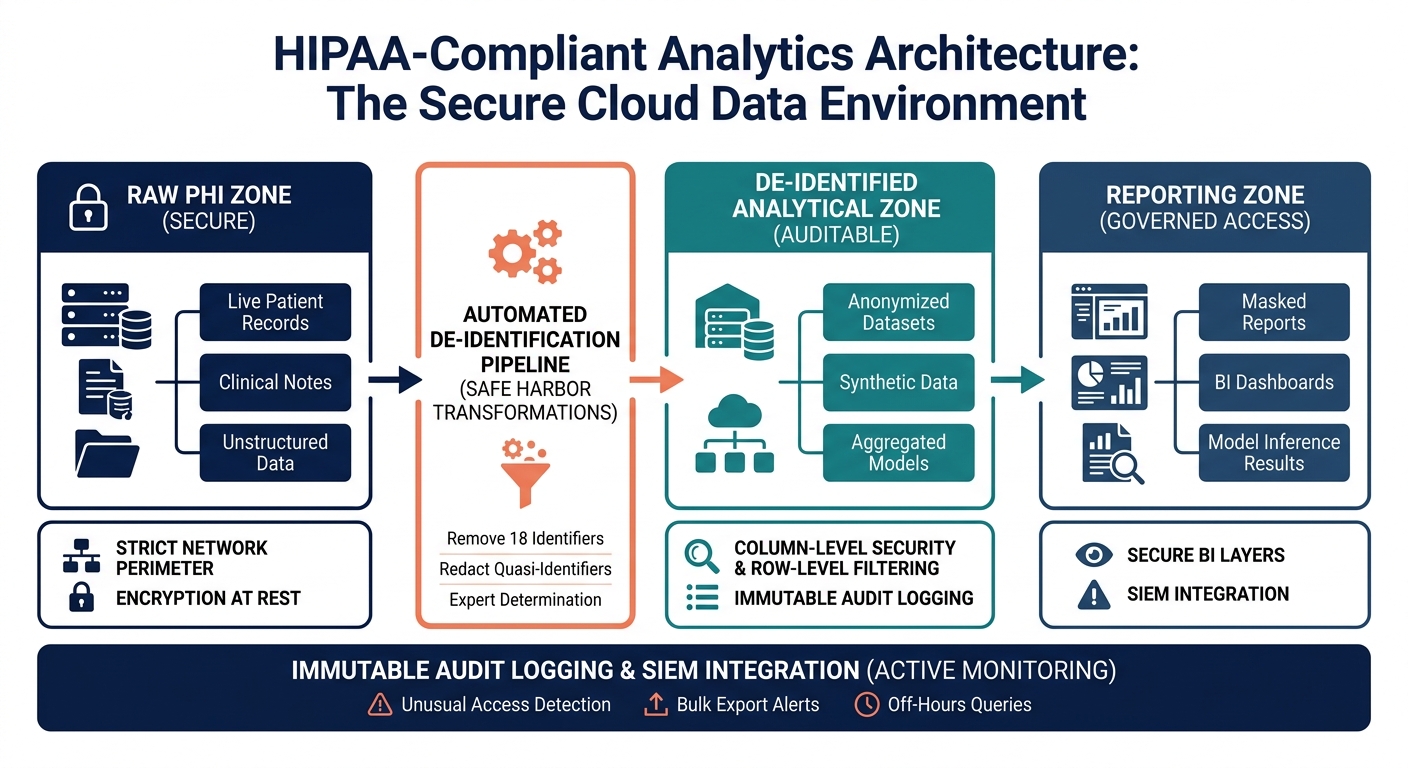
HIPAA-Compliant Analytics: Architecting Secure Cloud Data Environments for Healthcare
Building analytics infrastructure on patient data requires more than signing a Business Associate Agreement with your cloud provider. This guide covers the architectural decisions, de-identification techniques, and compliance controls that separate a genuinely secure healthcare data environment from one that only looks compliant on paper.

5 Data Analytics Strategies That Actually Drive Revenue Growth
Companies leveraging customer analytics are 23% more profitable. This guide covers the five proven analytics strategies — CLV modeling, churn prediction, dynamic pricing, attribution modeling, and operational optimization — with implementation frameworks and real-world results.